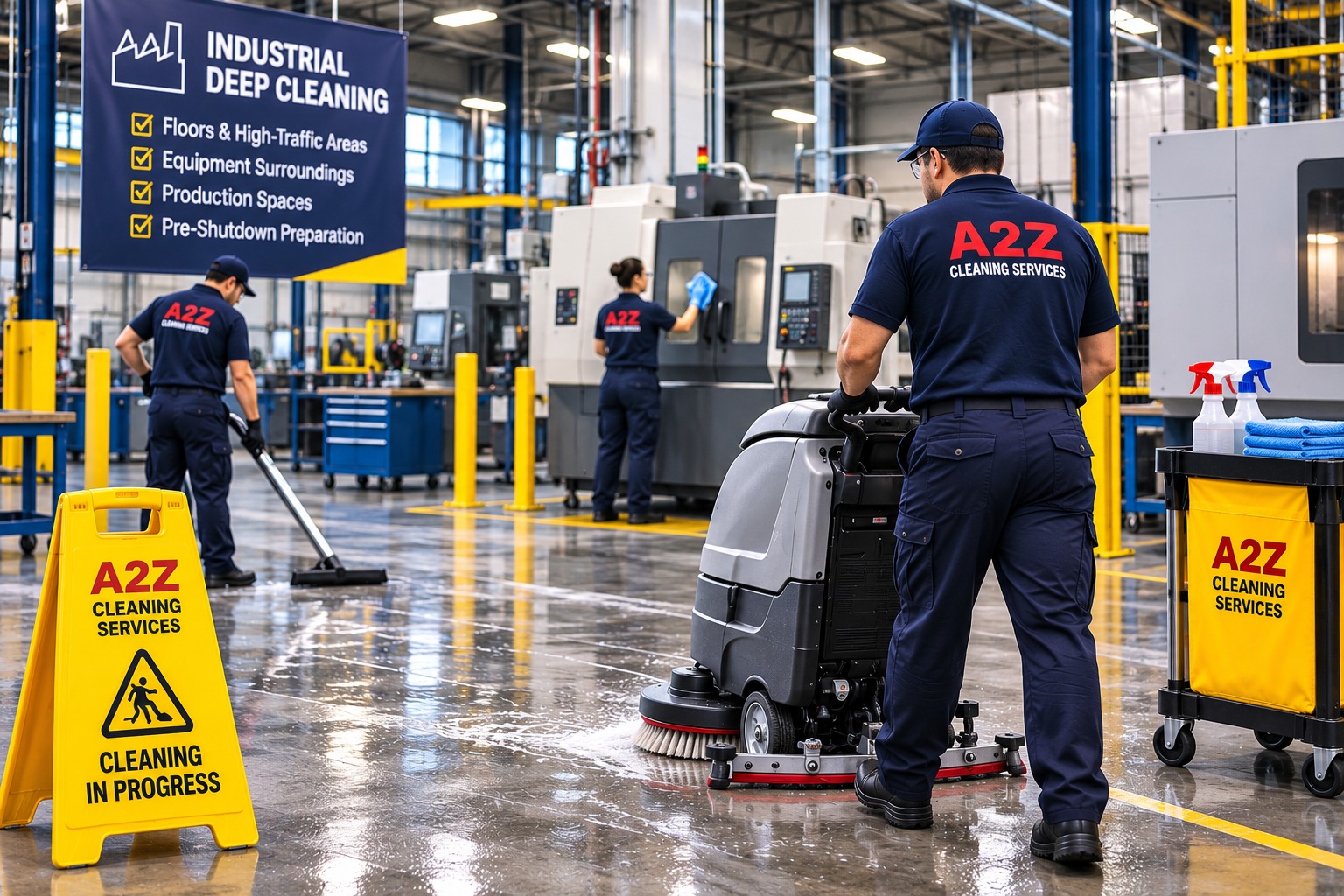
A manufacturing facility rarely gets a quiet day. Production schedules, equipment movement, deliveries, maintenance work, and employee traffic leave little room for the detailed cleaning that busy industrial environments often require.
Over time, dust can collect around accessible equipment areas, grease can build up on suitable surfaces, and debris can accumulate along production floors, storage areas, and warehouse traffic routes.
For plant managers, operations directors, maintenance supervisors, and facility teams, these conditions can become another concern when planning a year-end shutdown.
How can you address accumulated cleaning needs without interfering with production, maintenance work, or the planned restart?
That is where industrial deep cleaning in Ontario becomes a valuable part of shutdown preparation.
A planned cleaning program allows facilities to review areas that are difficult to access during ordinary operating hours, coordinate with maintenance teams, and prepare workspaces before regular operations resume.
For manufacturers and industrial businesses in London and Southwestern Ontario, professional industrial cleaning services can support customized cleaning scopes for warehouses, production floors, and other suitable industrial workspaces.
Why Year-End Shutdowns Are an Opportunity for Industrial Deep Cleaning
Many industrial facilities schedule planned downtime for maintenance, inventory activities, operational changes, or holiday closures.
Not every facility shuts down at the end of the year, and shutdown schedules vary by industry. However, when downtime is already planned, it may provide an opportunity to complete cleaning tasks that are difficult to coordinate during normal production.
For example, heavily used warehouse aisles may be easier to clean when equipment movement is temporarily reduced. Some production-adjacent areas may become accessible once operations and maintenance activities have been safely completed.
The important consideration is coordination.
Industrial cleaning should never interfere with machinery isolation, repairs, inspections, testing, or restart procedures. Cleaning activities must be planned around the facility’s established safety systems and the work being performed by authorized personnel.
In London, Ontario, manufacturing businesses, warehouses, distribution operations, and industrial properties face different cleaning challenges depending on production processes, building conditions, and the materials handled on site.
The same applies to facilities in St. Thomas, Woodstock, Ingersoll, Stratford, Kitchener, Waterloo, Cambridge, Windsor, and surrounding Southwestern Ontario communities.
A structured shutdown cleaning plan helps ensure that each facility receives the attention appropriate to its actual conditions rather than relying on a generic industrial cleaning checklist.
What Areas Should Be Included in Industrial Shutdown Cleaning?
Industrial deep cleaning should begin with a site assessment. The goal is to identify accumulated soil, accessible cleaning areas, operational restrictions, and any locations that require specialized safety procedures.
Production floors and traffic routes
Production floors may collect dust, packaging residue, tracked-in dirt, and grime from regular operations.
Appropriate floor cleaning can improve the appearance and maintainability of suitable concrete, sealed, or other industrial floor surfaces.
Cleaning methods should be selected according to surface condition, contamination, equipment traffic, and manufacturer guidance.
Warehouse and storage areas
Warehouse operations often generate dust and debris from pallets, cartons, packaging materials, and product movement.
When storage aisles and accessible floor areas are available, planned cleaning can address accumulated debris beneath permitted work zones and along regular traffic paths.
Cleaning near stored goods or racking must follow site access and material-handling procedures.
Equipment surroundings
Dust and residue may accumulate on accessible exterior surfaces, around equipment bases, and in nearby work areas.
These locations require careful planning because machinery may contain electrical, mechanical, hydraulic, thermal, or other hazards.
Cleaning providers should only work in areas authorized by the facility, after the applicable isolation and access requirements have been satisfied.
Loading docks and receiving areas
Dock areas frequently collect dirt, tire marks, packaging fragments, moisture, and tracked-in residue.
Before winter operations become more demanding, cleaning these areas can help facilities maintain a more organized transition between outdoor and indoor workspaces.
Employee and support areas
Break rooms, washrooms, locker areas, offices, and shared corridors also benefit from a seasonal cleaning review.
These spaces affect employee comfort and should remain part of a facility’s wider maintenance plan, even when the main cleaning project focuses on production or warehouse areas.
Industrial Deep Cleaning Checklist for Year-End Shutdowns
A written checklist helps operations managers, maintenance teams, and cleaning providers agree on the scope before work begins.
| Facility Area | Cleaning Priority | Planning Considerations |
|---|---|---|
| Production floors | Remove suitable surface dirt, dust, residue, and accumulated debris. | Confirm floor type, equipment isolation, access routes, and required drying time. |
| Warehouse aisles | Sweep or scrub accessible floor areas and remove permitted debris. | Coordinate with forklift traffic, inventory movement, and racking restrictions. |
| Equipment surroundings | Clean approved external surfaces and accessible surrounding areas. | Obtain authorization and comply with machinery isolation and site safety procedures. |
| Loading docks | Address debris, dirt, floor residue, and approved dock-area surfaces. | Coordinate with shipping, receiving, vehicle movement, and winter access needs. |
| Storage and staging areas | Remove accessible dust and packaging residue. | Protect inventory and confirm which areas can be entered or moved. |
| Walls and accessible ledges | Remove appropriate surface dust and accumulated residue. | Confirm height, access equipment, surface compatibility, and fall protection requirements. |
| Break rooms and washrooms | Deep clean floors, fixtures, counters, and other approved surfaces. | Arrange staff access and allow adequate time for cleaning and drying. |
| Office and administrative areas | Clean carpets, hard floors, glass, shared spaces, and accessible surfaces. | Protect documents, electronics, and sensitive work materials. |
This checklist is a starting point, not a substitute for a site-specific risk assessment.
Facilities handling hazardous substances, food products, combustible dust, or other controlled materials may require specialized procedures and contractors beyond the scope of ordinary industrial cleaning.
How to Coordinate Industrial Cleaning With Maintenance and Safety Teams
One of the biggest mistakes during a planned shutdown is treating cleaning as an isolated activity that can happen whenever production stops.
In reality, shutdown periods may involve maintenance technicians, electricians, contractors, equipment inspectors, engineers, and operational staff working within the same building.
Cleaning tasks must be coordinated with these activities.
Confirm equipment isolation and authorization
Equipment must not be assumed safe simply because production has stopped.
Before cleaning begins near machinery, the facility must confirm the appropriate isolation, lockout, access, and authorization requirements.
Only qualified and authorized personnel should perform tasks involving machinery isolation or hazardous energy control.
Review cleaning products and materials
Cleaning products must be suitable for the intended surfaces and site conditions.
Workers should follow applicable WHMIS requirements, product labels, safety data sheets, and workplace procedures.
Cleaning plans should also consider ventilation, potential incompatibilities, electrical equipment, and sensitive materials.
Plan work around other contractors
Maintenance work may generate additional dust, debris, or residue after a cleaning area has already been completed.
Where practical, cleaning should be scheduled after activities likely to create new contamination, while respecting site-specific safety and access restrictions.
Control access during cleaning
Industrial floor cleaning may introduce temporary wet surfaces, equipment movement, hoses, or restricted walking routes.
The facility should establish appropriate signage, barriers, traffic separation, and communication procedures.
Cleaning activities should not obstruct emergency exits or essential safety equipment.
A coordinated plan helps reduce interference between teams and makes the shutdown period more productive.
How to Plan Industrial Deep Cleaning Without Delaying Production
The most effective industrial cleaning projects begin before the shutdown date.
Waiting until the final production shift to define the scope can create unnecessary uncertainty about access, equipment, staffing, and the time required.
A practical plan should address three priorities.
Step 1: Conduct a facility walkthrough
Walk through the site with the facility manager or an authorized representative.
Review production areas, warehouse floors, docks, staff facilities, equipment surroundings, and permitted storage spaces.
Identify visible buildup, restricted areas, unusual contamination, sensitive equipment, and tasks that require specialized procedures.
The walkthrough should result in a clear list of areas that are suitable for the proposed cleaning service.
Step 2: Agree on the cleaning scope and schedule
Define which areas will be cleaned, the methods to be used, the responsibilities of each team, and any preparation required before work begins.
The schedule should account for shutdown activities, authorized access, available utilities, waste management, floor drying, and the facility’s planned restart.
For larger facilities, dividing the work into approved zones can make scheduling and quality checks easier.
Step 3: Inspect completed work before restart
After cleaning, conduct a walkthrough to confirm that the agreed scope has been completed.
Check for remaining residue, waste, equipment left behind, wet surfaces, and access restrictions that must be resolved before normal activities resume.
Cleaning completion does not itself authorize equipment restart. Operational clearance remains the responsibility of the facility’s designated personnel.
A2Z Building Maintenance provides industrial cleaning services for factories, warehouses, and specialized workspaces throughout London and Southwestern Ontario. Its services include industrial floor care and cleaning programs tailored to facility workflows and operational requirements.
If your facility is planning a year-end shutdown and needs a defined industrial cleaning scope, Request your free quote.
Why November Is a Good Time to Schedule Year-End Cleaning
November is a useful planning period for facilities with shutdowns scheduled in December or around the end of the calendar year.
By planning ahead, operations teams can review the scope, confirm contractor access, identify equipment requirements, and coordinate cleaning with maintenance activities.
It also provides time to identify work that should not be included in a standard cleaning contract.
For example, hazardous waste remediation, internal machinery servicing, confined-space work, and other specialized industrial activities may require separate contractors with specific qualifications.
Early planning makes those distinctions clearer before the shutdown begins.
For warehouses and manufacturing facilities preparing for colder weather, this is also an opportunity to review the condition of receiving areas, staff entrances, industrial floors, and winter traffic routes.
Our related guide to warehouse cleaning before winter in Ontario provides additional guidance on managing salt, debris, docks, and high-traffic areas.
How to Compare Industrial Shutdown Cleaning Quotes
Industrial cleaning quotes should be evaluated according to scope, site requirements, safety arrangements, and expected deliverables rather than price alone.
Before choosing a provider, ask the following questions:
- Which production, warehouse, and support areas are included?
- What cleaning equipment and methods are proposed?
- Are equipment surroundings included, and what access conditions apply?
- What site safety documentation and training are required?
- Who is responsible for machinery isolation and access authorization?
- How will cleaning be coordinated with maintenance contractors?
- Who handles waste, and which materials are excluded?
- What happens if the scope changes during the shutdown?
- How are quality checks and completion documented?
- What drying or access restrictions must be cleared before reopening?
A written scope of work helps managers compare proposals fairly and reduces misunderstandings during a limited shutdown window.
Some facilities may benefit from a fixed project price when the work is clearly defined. Others may need a time-and-materials arrangement for uncertain or variable tasks.
For a closer comparison, see our article on fixed cleaning contracts versus time and materials billing.
Where the shutdown includes renovation or construction-related work, commercial cleaning services can provide a starting point for discussing whether additional specialized cleaning is needed.
Prepare Your Facility for a Cleaner Restart
The value of a well-planned shutdown cleaning project becomes clear when the facility is preparing to resume normal operations.
Approved work areas have been cleaned, debris has been removed from the agreed zones, floors have been maintained using suitable methods, and support spaces are ready for employees returning to work.
Maintenance teams have clear documentation of cleaning completion, and operational staff can focus on their own inspections and restart responsibilities.
Without a coordinated plan, facilities may encounter avoidable problems: overlapping contractor schedules, inaccessible work areas, unfinished cleaning tasks, or surfaces that need additional attention before they can be used.
Industrial deep cleaning in Ontario should be treated as one part of broader facility readiness rather than a last-minute cosmetic task.
The goal is not to promise that cleaning alone will improve production performance or eliminate workplace risk. It is to provide a cleaner, more organized environment that supports established maintenance, safety, and operational procedures.
With early planning, clear responsibilities, and the right cleaning scope, a year-end shutdown can become an opportunity to address accumulated cleaning needs before the next production cycle begins.
Frequently Asked Questions
When should industrial facilities schedule year-end deep cleaning?
Industrial facilities should begin planning deep cleaning before the scheduled shutdown, allowing time for a walkthrough, scope development, contractor coordination, and safety review. November can be useful for December shutdowns, but timing depends on production schedules, maintenance activities, equipment access, and the facility’s restart requirements. Early planning helps reduce scheduling conflicts.
What areas are typically included in industrial shutdown cleaning?
Industrial shutdown cleaning may include approved production floors, warehouse aisles, loading docks, storage areas, accessible equipment surroundings, and employee facilities. The exact scope depends on site conditions and safety restrictions. Machinery interiors, hazardous materials, confined spaces, and specialized remediation should not be assumed included without separate assessment and appropriate authorization.
Can industrial cleaning take place during equipment maintenance?
Industrial cleaning can sometimes occur during a planned maintenance period, but activities must be coordinated and separated where necessary. Equipment isolation, contractor access, hazardous energy controls, and site safety procedures take priority. Cleaning personnel should only enter authorized areas, and operational managers remain responsible for approving access and equipment restart.
How do I compare industrial deep cleaning quotes in Ontario?
Compare quotes by written scope, cleaning methods, staffing, equipment, safety requirements, scheduling, waste handling, exclusions, and quality checks. Confirm which areas are included and who authorizes access near machinery. Ask how unexpected work is priced and how completion is documented before the facility resumes normal operations.
Plan your shutdown cleaning with a clear scope and a schedule that fits your facility. Request your free quote.