You want a clean facility, but you also want to understand exactly what you are paying for. If your monthly cleaning invoice feels too rigid, too vague, or disconnected from how your building is actually used, it may be time to compare a janitorial contract vs time and materials model.
For office managers, facility managers, condo boards, clinic administrators, restaurant owners, industrial operators, and property managers, cleaning costs are not only about price. They affect budgeting, staff confidence, tenant satisfaction, customer impressions, inspection readiness, and how quickly your facility can respond when needs change.
The external problem is usually easy to identify: washrooms need attention, floors need care, garbage needs removal, kitchens need cleaning, and high-touch areas need consistency. The internal frustration is more complicated. You may be wondering whether a fixed monthly contract gives you enough flexibility, or whether time and materials billing will make costs harder to predict.
For facilities that need a flexible service model, professional time and materials cleaning services can help match cleaning labour and supplies to the actual work required, rather than forcing every facility into the same fixed plan.
Janitorial Contract vs Time and Materials: What Is the Difference?
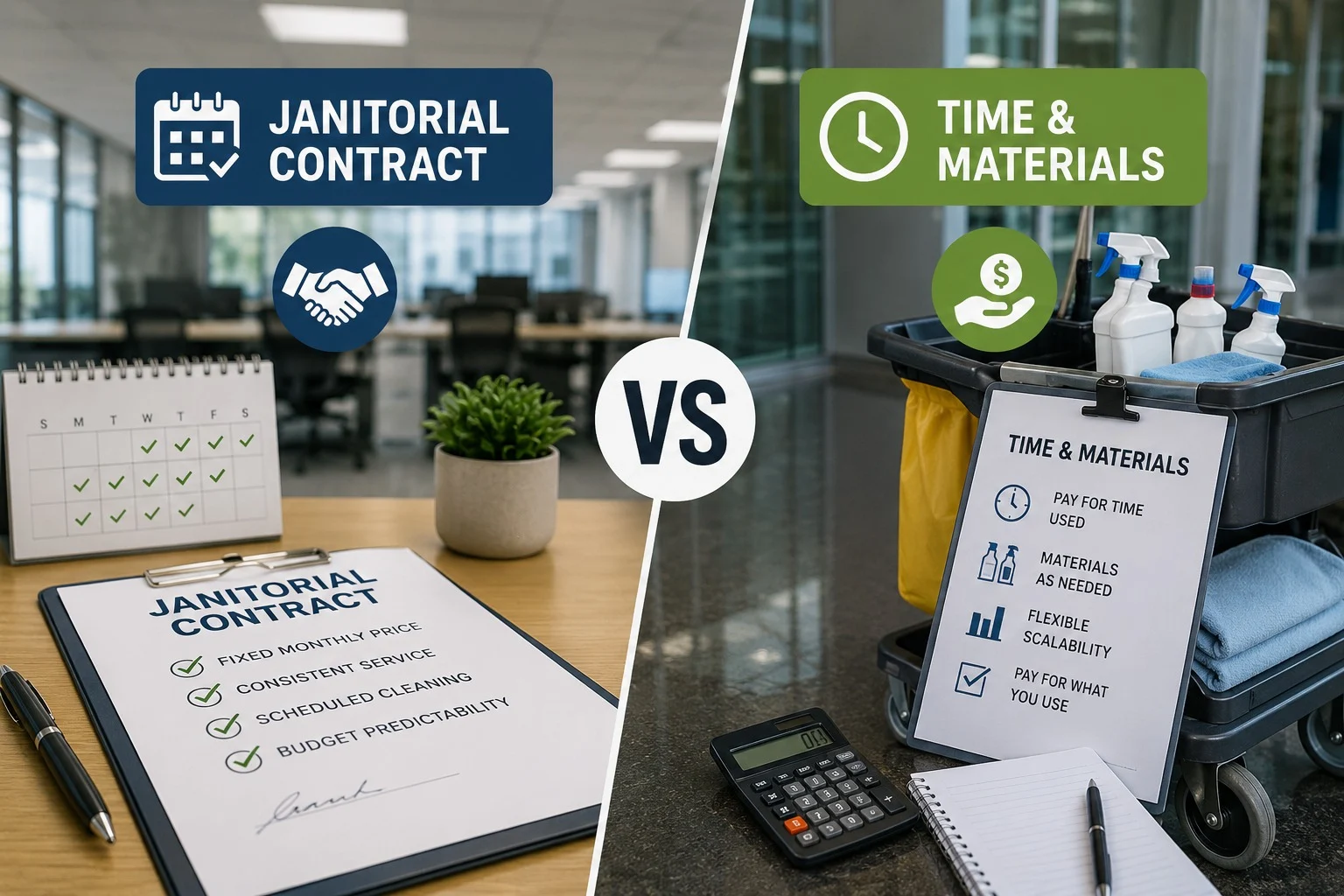
A janitorial contract vs time and materials comparison starts with how the work is priced and managed. A janitorial contract usually provides a fixed recurring service scope for a set monthly price. Time and materials billing is usually based on the labour time, supplies, and materials actually used for the work performed.
In London, Ontario, both models can make sense depending on the building. A professional office near downtown London may benefit from predictable evening cleaning. A medical clinic may need consistent daily service plus seasonal deep cleaning. An industrial facility may need flexibility when production schedules, dust levels, or project work change.
The best model depends on your traffic patterns, building type, cleaning frequency, budget expectations, and how often your needs change. A fixed contract can simplify planning when the scope is stable. Time and materials can be useful when the work varies, when projects are unpredictable, or when you want more transparency around labour and supplies.
The important point is not which model sounds cheaper. The important point is which model gives your facility the right level of cleanliness, accountability, and cost control.
What Is Included in a Fixed Janitorial Contract?
A fixed janitorial contract usually includes a defined list of recurring tasks. These may include washroom cleaning, garbage and recycling removal, vacuuming, mopping, dusting accessible surfaces, kitchen or lunchroom cleaning, entrance cleaning, high-touch point care, and routine supply restocking if included in the agreement.
This model works well when your facility has predictable use. For example, an office with consistent staffing, regular operating hours, and stable cleaning needs may prefer a set monthly price. A condo building may also prefer a fixed scope for lobbies, elevators, corridors, garbage rooms, and amenity spaces.
The strength of a contract is predictability. You know what is scheduled, when it happens, and what the monthly cost should be. This helps with budgeting and reduces the need to approve every routine task separately.
The risk is that the scope may become outdated. If your building becomes busier, if winter salt increases floor care needs, if staff return to the office more often, or if washroom complaints increase, the original contract may no longer match reality.
What Is Time and Materials Cleaning?
Time and materials cleaning is a pricing model where the cost is based on the time spent, labour provided, supplies used, and materials required for the job. Instead of paying a fixed monthly amount for a fixed scope, the service can be adjusted based on the actual work needed.
This model can be useful for facilities with changing conditions. Examples include post-renovation cleaning, seasonal deep cleaning, project-based janitorial support, temporary staffing gaps, event cleanup, emergency cleaning, and buildings where usage changes from week to week.
Time and materials can also help when the scope is hard to define before work begins. For example, a neglected floor, a dusty industrial area, a heavily used restaurant space, or a common area after a busy event may require more hands-on assessment before the final effort is clear.
The strength of this model is flexibility and transparency. The risk is that costs may be less predictable if the work is not clearly managed. That is why time and materials should still have a written scope, agreed rates, clear reporting, and communication before the work begins.
Which Pricing Model Fits Your Facility Best?
The right model depends on how stable your cleaning needs are. A facility with consistent traffic and routine cleaning requirements may benefit from a fixed monthly janitorial contract. A facility with changing needs, project work, seasonal demand, or uncertain scope may benefit from time and materials.
| Facility Situation | Best-Fit Model | Why It May Work |
|---|---|---|
| Stable office with predictable hours | Fixed janitorial contract | Recurring tasks and steady traffic make monthly budgeting easier. |
| Clinic with daily patient traffic | Fixed contract with added deep cleaning as needed | Routine cleaning stays consistent while seasonal or special work can be scheduled separately. |
| Condo or apartment common areas | Fixed janitorial contract | Lobbies, elevators, hallways, and garbage rooms need consistent recurring attention. |
| Restaurant after a busy patio season | Time and materials or project cleaning | Tile, grout, washrooms, and service paths may need deeper work beyond the routine scope. |
| Industrial or warehouse facility with changing operations | Time and materials | Dust, debris, production schedules, and cleaning requirements may vary by project or season. |
| Post-construction or renovation cleanup | Time and materials | The final workload can depend on dust, debris, trades, access, and project condition. |
| Retail or commercial property before a seasonal reset | Blended model | Routine cleaning can stay contracted while special seasonal work is billed separately. |
This comparison is not about choosing one model forever. Many Ontario facilities use a blended approach: a fixed janitorial contract for routine service, plus time and materials for extra work, seasonal deep cleaning, emergency requests, or projects that fall outside the regular scope.
When a Fixed Janitorial Contract Makes Sense
A fixed janitorial contract makes sense when your cleaning needs are stable, repeatable, and easy to define. If your building has consistent operating hours, predictable staff traffic, and a clear list of recurring tasks, a contract can keep cleaning simple and manageable.
This model is often helpful for offices, condo buildings, schools, clinics, gyms, retail spaces, and commercial properties that need reliable day-to-day service. It can cover daily, weekly, or several-times-per-week cleaning depending on the size and use of the facility.
The main benefit is consistency. Staff, tenants, customers, patients, and visitors experience a cleaner space because cleaning is scheduled, not improvised. Facility managers also have a clearer budget and fewer small approvals to manage.
A fixed contract should still be reviewed regularly. Ontario buildings change with the seasons. Winter salt can increase floor cleaning needs. Summer humidity can affect odours. Flu season can increase attention on high-touch surfaces. A contract that worked in May may need adjustments by November.
When Time and Materials Billing Makes Sense
Time and materials billing makes sense when the work is difficult to predict or when you need flexibility. This can include one-time cleaning projects, seasonal resets, move-in or move-out cleaning, renovation cleanup, event cleaning, emergency cleaning, deep cleaning, and facilities with changing schedules.
It can also work well when you do not want to commit to a fixed scope before the full condition of the facility is understood. If a warehouse has unexpected dust buildup, if a restaurant floor needs detailed grout cleaning, or if a building has been under-cleaned for months, the actual labour required may be hard to estimate from a quick description.
Time and materials can also support businesses during staff shortages. If your internal team is away, if a contractor misses work, or if a property needs temporary extra cleaning, this model can fill the gap without rewriting the whole janitorial contract.
A2Z Cleaning Services becomes the guide here because facility teams should not have to guess which billing model protects both cleanliness and budget. As a LIUNA Local 1059 member commercial cleaning and janitorial company with trained bonded staff and a local Southwestern Ontario presence, A2Z understands how to match cleaning plans to real facility needs.
A Simple 3-Step Plan to Choose the Right Cleaning Model
If you are unsure which model fits, use a simple decision process. The goal is to avoid overpaying for unnecessary service while also avoiding under-cleaning that creates complaints, safety concerns, or poor first impressions.
1. List your routine cleaning needs
Start with the tasks that must happen every day or every week. This may include washrooms, garbage, kitchens, floors, entrances, high-touch points, offices, lobbies, elevators, and staff areas.
If these needs are predictable, a fixed janitorial contract may be the best foundation. It gives your building a consistent baseline.
2. Identify variable or seasonal work
Next, list the tasks that happen occasionally or change by season. This may include floor stripping and waxing, carpet cleaning, tile and grout cleaning, window cleaning, post-construction cleanup, event cleaning, winter salt recovery, or deep cleaning before inspections.
If these tasks are irregular, time and materials may be a better fit than forcing them into a fixed monthly scope.
3. Compare total value, not just monthly price
Look beyond the lowest monthly number. Ask whether the quote includes supervision, supplies, access, communication, quality checks, seasonal changes, and extra work outside the standard scope.
If you need help choosing the right cleaning model for your facility, Request your free quote.
Why August Is a Good Time to Review Cleaning Agreements
August is a practical time for Ontario businesses to review cleaning agreements because fall and winter create new facility pressures. Staff return from summer schedules, offices become busier, schools and clinics see routine traffic increase, restaurants shift from patio season to indoor dining, and winter planning begins.
This is also when many property managers and facility teams start thinking about budgets, service gaps, seasonal floor care, flu season cleaning, and whether current cleaning support is still enough.
If your facility experienced complaints during summer, August is a good time to decide whether those issues were caused by an unclear scope, insufficient frequency, or the wrong billing model. A fixed contract may need to be updated. A time and materials option may need to be added for special projects.
For businesses across London, St. Thomas, Strathroy, Woodstock, Ingersoll, Stratford, Kitchener, Waterloo, Cambridge, and Windsor, the right model can reduce frustration before the harder cleaning season arrives.
How to Compare Janitorial Quotes Fairly
When comparing janitorial quotes, do not compare only the final price. Compare the scope, frequency, staffing, supplies, supervision, reporting, access requirements, exclusions, and process for extra work.
Ask whether the quote is fixed, time and materials, or blended. Ask how additional requests are approved. Ask whether seasonal cleaning is included or separate. Ask what happens if the facility needs extra labour after a storm, event, renovation, inspection concern, or unexpected mess.
For a deeper look at evaluating providers, this related reading may help: how to choose a commercial cleaning company in London, Ontario.
For facilities that need consistent recurring service, professional janitorial services can help maintain the daily cleaning standard while time and materials support is used for flexible or project-based work.
What Success Looks Like With the Right Billing Model
Success looks like a cleaning plan that matches your building instead of forcing your building into the wrong structure. Routine tasks happen reliably. Extra work is handled clearly. Invoices make sense. Managers know what is included, what is separate, and how to request changes.
Your washrooms stay fresh, floors look maintained, staff feel supported, tenants complain less, and your budget is easier to explain. When seasonal or project work comes up, the process is clear instead of stressful.
Failure looks different. A fixed contract may feel too limited, with important tasks excluded. A time and materials arrangement may feel unpredictable if there is no clear scope. Staff may complain, managers may chase issues, and cleaning may become a recurring operational frustration.
When the model is right, your facility pays for what it truly needs, cleaning standards are easier to maintain, and decision-makers have better control over both service and cost.
FAQ
What is the difference between a janitorial contract and time and materials?
A janitorial contract usually provides recurring cleaning for a fixed monthly price and defined scope. Time and materials billing is based on labour time, supplies, and materials used for the work performed. Contracts are best for predictable cleaning, while time and materials can fit variable, seasonal, or project-based needs.
Is time and materials cleaning more expensive than a fixed contract?
Not always. Time and materials may cost more for frequent routine work, but it can be more practical for irregular projects, seasonal deep cleaning, or uncertain scopes. The best value depends on how often cleaning is needed, how predictable the work is, and how clearly the provider tracks labour and supplies.
Can a facility use both pricing models?
Yes. Many Ontario facilities use a fixed janitorial contract for routine cleaning and time and materials billing for special work. This blended model can cover daily washrooms, floors, garbage, and touchpoints through a contract while using flexible billing for deep cleaning, floor care, events, or emergency requests.
How do I choose the right janitorial pricing model?
Choose based on stability, scope, and flexibility. If your cleaning needs are predictable, a fixed contract may work best. If your needs change by season, project, event, or facility condition, time and materials may fit better. Compare written scopes, exclusions, approval process, supervision, and communication before deciding.